Is My Child Behind in Music Lessons?
It’s a quiet question many parents ask, sometimes out loud, often privately: “My child has been taking lessons for a year… shouldn’t they be further along?” Or: “Other kids seem more advanced.” Here’s the honest answer: music progress does not move at the same speed for everyone, and that’s completely normal.
Probably not. If your child is showing up, learning and slowly building skills, they aren’t behind. They’re developing, and development takes time.
- Compare your child to themselves, not to others
- There’s no universal timeline for music
- Slow progress alone isn’t a warning sign
Comparison Is the Fastest Way to Lose Perspective
Every student brings something different to lessons: different attention spans, coordination, practice habits, personalities and maturity timelines. Two students can start at the same time and look completely different after six months. That doesn’t mean one is “ahead” and the other is “behind.” It means they are different.
Music is not a race. There is no universal chart that says “at month 8 you should be here.” Real progress depends on consistency, comfort level and how the student processes learning.
Social Media and the Illusion of Speed
We live in a highlight culture.
The 10-year-old playing advanced repertoire, the teen posting a perfect drum solo, the recital clip where everything went right.
The years of practice, the missed notes, the slow middle stages and the plateaus.
It’s easy to compare your child’s full journey to someone else’s highlight moment. That rarely leads to clarity.
What “Behind” Usually Means
When parents say their child is behind, they usually mean one of three things:
- Progress feels slower than expected. Often the student is building foundational skills. Foundations aren’t flashy, but they’re essential.
- Another student appears more advanced. Usually they practice more hours at home. That’s not ability; that’s time invested.
- Practice isn’t consistent. Sometimes life is simply busy.
None of those equal failure.
Late Starters Are Not Disqualified
Some children begin at five, some at ten, some at fifteen. Starting later does not eliminate success. Older beginners often understand instruction better, practice more independently and move quickly once motivated. Age matters less than consistency.
The Signs That Actually Matter
Instead of asking “Are they behind?” try asking:
- Are they improving compared to themselves?
- Are they more comfortable at the instrument than six months ago?
- Are they developing better rhythm, tone or confidence?
- Are they learning how to stick with something?
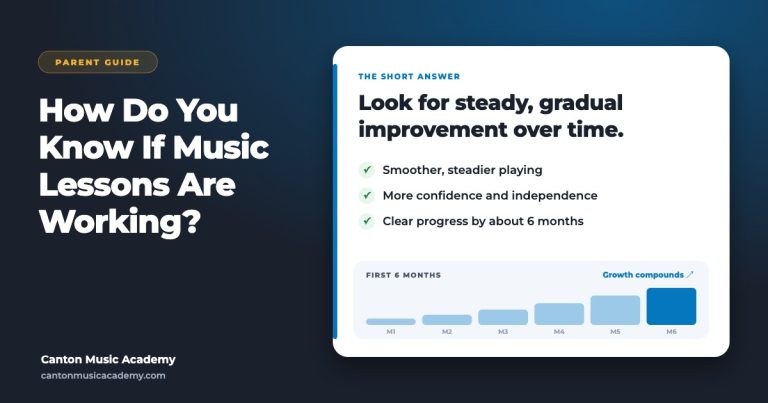
Growth in music is often subtle. You may not see dramatic leaps every week, but over months the change becomes clear.
Plateaus and sudden jumps are normal. See the progress graph in Why Progress Isn’t Always Linear.
When to Be Concerned
There are rare situations where concern makes sense: the student is completely disengaged, there’s ongoing resistance with no interest, or lessons feel stressful every week. In those cases, it’s worth having a conversation with us. But slow progress alone is not a warning sign. It’s part of learning.
Music Is a Long-Term Skill
The students who feel proud of their playing later are rarely the ones who moved fastest at the beginning. They’re the ones who stayed steady. Music rewards patience. If your child is showing up, learning and slowly building skills, they are not behind. They are developing.
“Behind” FAQ
How long does it take to learn an instrument?
There’s no single answer. Most students feel clear progress by about six months of consistent lessons and practice, and a real foundation after one to two years.
Would more practice help my child catch up?
Consistent, short practice helps more than anything. But “catching up” to another student isn’t the goal; steady improvement is.
Is it too late for my 12-year-old to start?
Not at all. Older beginners often progress quickly because they understand instruction and can practice independently.
The Parent Guide to Music Lessons
Straight answers to the questions parents ask us most.
Getting started
Practice & progress
Questions About Your Child’s Lessons?
Every student is different. Call, text or stop by and we’ll help you find what works for your child and your schedule.
Also from our family of schools: Grosse Pointe Music Academy and Brighton Music Academy.